
What Is Osmolality?
An overview
Definition
Osmolality is a measurement of the total number of solutes in a liquid solution expressed in osmoles of solute particles per kilogram of solvent (osmol/kg).
Applications
Living cells are often sensitive to changes in osmolality, as water can rush in or out of their porous cell membranes in response, causing cells to burst or shrink. Therefore, testing osmolality of various solutions enables assessment of cell functioning and volume. This is relevant in two different settings:
Bioprocessing
From the development of a biopharmaceutical drug to the final product formulation and fill, bioprocessing involves many complex operational steps. Ensuring that this process consistently generates a solution of predetermined yield and purity is a key factor for the highest quality in the final product.
An important parameter to achieve consistent results in process fluids is the solute concentration. As a fast, easy to implement and reliable measure of concentration, osmolality is therefore considered a critical quality attribute and critical process parameter in bioprocessing.
Osmolality in Bioprocessing
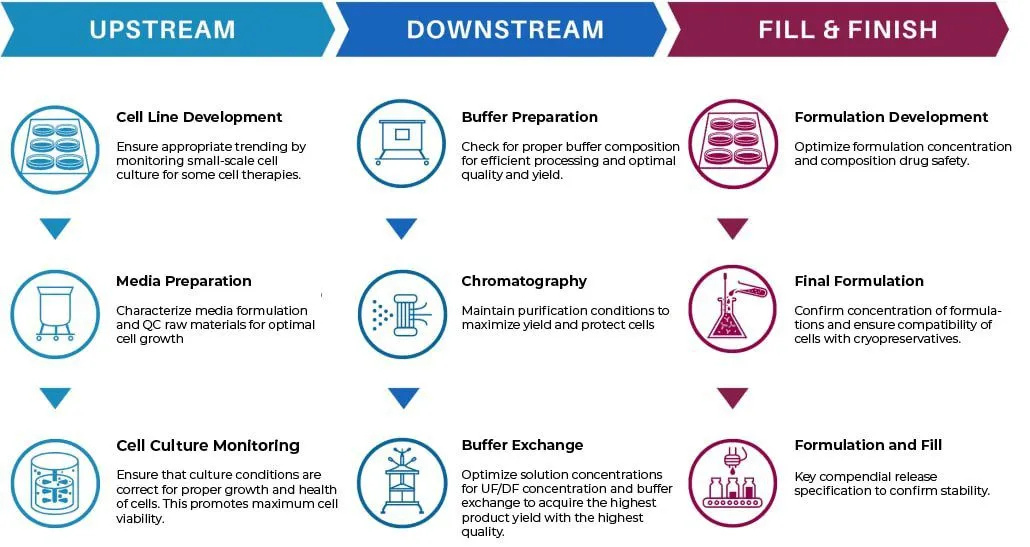
Osmolality testing is used in bioprocessing to
- Control raw material and drug product consistency
- Ensure input materials can support healthy cell growth
- Prevent damage to a biologic drug during purification
- Preserve optimal efficacy and stability during formulation and storage
- Prevent adverse reactions during delivery
Clinical Chemistry
Clinical labs test osmolality of serum, plasma and urine because it provides information on the body’s water and electrolyte balance. Abnormal osmolality levels are typically an indicator of a serious homeostatic imbalance, often due to renal dysfunction, diabetes, infection or poisoning. For this reason, measuring osmolality is critical when you suspect toxin ingestion, electrolyte disorders and metabolic acidosis.
Osmolality is a quick and cost-effective test used in clinical settings to
- evaluate the body’s water balance and its ability to produce and concentrate urine to assist in diagnosing patients
- investigate low sodium levels (hyponatremia), and identify the underlying cause
- detect the presence of toxins in the body, enabling early intervention
- monitor the electrolyte balance of patients receiving osmotically active drug therapies (e.g. mannitol used to treat cerebral edema), allowing doses to be adjusted as needed
- monitor the effectiveness of a treatment or a condition found to be adversely affecting a person’s osmolality
Osmolality testing with osmometers
Osmolality is measured using a device called an osmometer. These instruments measure osmotic concentration on the scale of milliosmoles (mOsm) per unit of weight (mOsm/kg): This means they operate on an order of a thousand times smaller than an osmole.
Freezing point osmometers are commonly used to determine osmolality.
We offer a broad assortment of high-quality osmometers from Advanced Instruments, part of Nova Biomedical, to suit your bioprocessing or clinical diagnostics lab.
Contact specialist Linda Zandi for more information.
OsmoTECH® HT Automated Micro-Osmometer
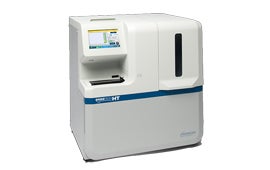
Optimize your high-throughput osmolality testing workflow
- Automation-friendly 96-well plate-based format for high-throughput testing
- Preserve sample with small testing volume
- Powerful data integrity and management features for easy data tracking and compliance

OsmoTECH® XT Single-Sample Osmometer
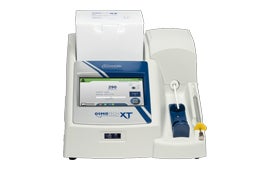
Best-in-class osmolality performance
- Intelligent freezing technology reliably and accurately tests a wide variety of samples including complex matrices and highly viscous samples (i.e. sugars and proteins)
- Small sample volume uses only 20 μLs for testing
- Fully supports 21 CFR Part 11, GMP, and EU Annex 11 compliance
OsmoTECH® PRO Multi-Sample Micro-Osmometer

Automation to fit your growing lab
- Just a 30 μL sample volume is needed, facilitating sample-limited applications
- Walk-away testing with 20-position turntable
- Data integrity features support 21 CFR part 11, GMP and EU Annex 11